
The Glass House at Seegreen Lodges, Hathipaon has floor-to-ceiling windows on three sides. At night, the valley goes dark and the glass becomes a mirror. In the morning — if the skies are clear, which they usually are between October and May — the first light falls across the bed before an alarm could. The room is built for two people. There is no television.
Most guests book it without fully knowing what they're walking into. By the second morning, most have already started thinking about when they can come back.
The Room Itself
The Glass House is a standalone room at the edge of the Seegreen property, set slightly apart from the Log Hut and the main cafe building. The windows face east and south — toward the valley and the forest ridge that frames it.
Inside: a double bed, a sitting area, a writing desk, and a bathroom. The room is heated. In winter (November–February), the temperature outside can drop to 0–4°C overnight; inside, with the heating on, it holds warmth. The glass stays slightly cold to the touch on freezing nights — there are extra blankets.
The floor-to-ceiling windows are the room's architecture. Furniture is minimal by design. There is no curtain on the main glass wall — guests who want privacy on the valley-facing side won't find it, and that is the point.
The First Night
Arriving in the evening, the glass reflects the interior back at you. The valley is invisible. Some guests find this disorienting — they came for a view and got a lamp-lit room that happens to have very large windows.
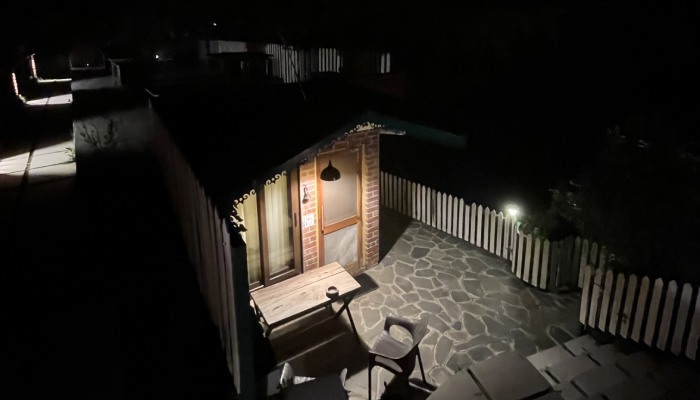
By 10 p.m., when the lights go off, the glass clears. On a full moon, the valley silhouette returns. Stars are visible from bed. This is the part guests tend to photograph — though photographs of the night sky through glass never look the way the eye sees it.
The forest at Hathipaon makes sounds after midnight. Not alarming ones — the wind, occasionally an owl, once in a while a dog barking somewhere down the ridge. The Glass House, being at the edge of the property, catches these sounds more than the main building does.
The Morning
This is what the room is built around.
The valley is visible from the moment the eye opens. In October and November, mist sits low in the folds below Hathipaon at 6 a.m. By 7:30, it has burned off and the Doon Valley opens out. In February and March, the light comes in at a lower angle and catches the dust on the glass — a reminder that the windows need wiping, and also that the sun has already started.
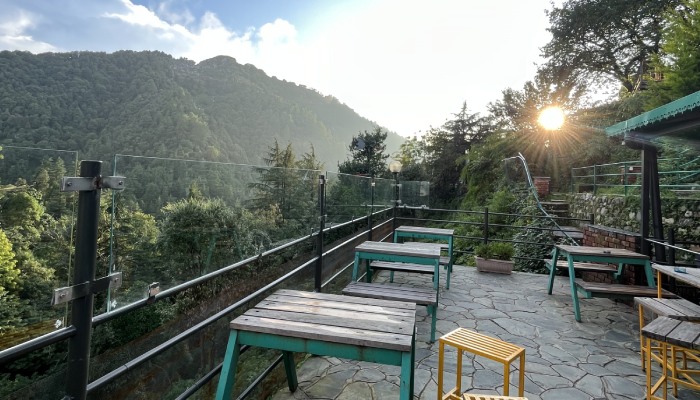
April is the most dramatic month in the Glass House. The rhododendron ridge to the east is in flower. The birds start at 5:30 a.m. — Khalij Pheasant, Red-billed Blue Magpie, things guests can't name but recognise by sound within a day.
There is no view of a Himalayan peak from the Glass House. This surprises some people. The property sits at 2,000 metres, facing the lower valley and the forested ridge — which changes colour and character by season in ways that a static peak does not. Guests who arrive expecting the Garhwal Himalaya to be visible sometimes adjust their expectations; guests who weren't expecting anything in particular tend to find the valley sufficient.
What the Glass House Is Good For
Long evenings with a book. Breakfast in bed while the valley wakes up. Cold mornings with a glass of ginger lemon honey tea ordered from the cafe and carried in. Two days of doing nothing on a specific schedule.
The room is for two people. It's not suitable as a four-person stay — the space and the atmosphere both resist that. Couples book it most often: anniversaries, birthdays, the kind of trip that gets planned with the phrase 'we just need to get away.'
How to Book
The Glass House books up early for October, November, and February–March weekends. Mid-week stays in these months are almost always available. Monsoon (July–September) brings low cloud and rain — the valley is often invisible for days at a stretch, which some guests love and others don't. Decide accordingly.
Bookings directly at seegreenlodges.com/booking. The Log Hut is the other premium room — it has a fireplace and a private sit-out rather than the full glass front. Both have the same breakfast and the same cafe.
If Tama is on the property during your stay — which she usually is — she may wander toward the Glass House door on her morning rounds. She won't come in. She'll assess the situation from outside and move on, or she won't. Either way, it happens on her schedule.
Frequently Asked Questions
Is the Glass House warm enough in winter?
Yes. The room has heating and extra blankets are provided. The glass is double-layered, which reduces cold transfer. On the coldest nights in January (-2 to 0°C outside), the room stays comfortable. Guests are advised to bring warm sleepwear — the bathroom floor is cold before the heating has had time to warm the room.
Is the Glass House private? Can people see in from outside?
The main glass wall faces the valley, not a public road or shared space. There is no building or path immediately in front of the glass. During the day, the view is outward — into forest and valley. A side blind is available on request. Guests who want complete privacy on all sides may be more comfortable in the Log Hut.
Is there a view of the Himalayan peaks from the Glass House?
The Glass House faces the lower valley and forested ridge rather than a direct Himalayan peak. On very clear days in winter (November–January), distant snow-covered ridges are occasionally visible on the horizon. This is not a guaranteed feature. The primary view is the valley, the forest edge, and the sky.
Can three or four people stay in the Glass House?
The Glass House is configured as a double room for two guests. An additional mattress can sometimes be arranged on the floor for a child, but the room is not designed as a group stay. For families or groups, the property has two Deluxe Rooms in addition to the Log Hut and Glass House.
What is the difference between the Glass House and the Log Hut at Seegreen?
The Glass House is built around the view — large windows, morning light, the valley as the focal point. The Log Hut has a private sit-out, a fireplace, and an attic sleeping area, making it warmer and more enclosed in character. Both rooms are premium and book for similar rates.
